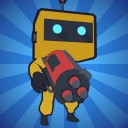
Guy, solo developer · November 2026
On October 2 I had a small Flutter prototype and a 600-line Go server stub. On November 4, Pew Pew Island went live on Google Play: a top-down 3D battle royale for phones. 50 players drop on an island, one walks out.
I built it alone, with Claude Opus 5.5 writing almost all of the code. 569 of the 599 commits are co-authored by Claude. My job was deciding what to build, playing it every day, and saying no.
The numbers
| First commit to Google Play | 33 days |
| Commits | 599, of which 569 co-authored by Claude |
| Go server | ~35,000 lines, tests included |
| Godot client | ~44,000 lines of GDScript, tests included |
| Tests | 621 Go test functions, 55 Godot test scripts |
| A match | 50 players, 30 ticks a second |
| Content | 6 maps, 40 heroes, solo / duo / quads, a zombie mode |
The stack
- Server: Go. It owns every rule: movement, bullets, loot, the storm.
- Client: Godot 4, mobile renderer. It draws the server’s snapshots and predicts only your own movement. There is no offline mode.
- Accounts: SQLite, backed up every minute.
- 3D art: free CC0 model packs (Quaternius, Kenney), re-rigged, repainted and exported by Blender Python scripts. No model is edited by hand; every
.glbis generated. Store portraits and key art were polished with an image model. - Sound: every sound effect is synthesized by one Python script. No samples, no sound library. A gunshot is filtered noise, a short crack and a low thump:
def gunshot(dur, cutoff, thump_hz, crack, seed, tail=0.06):
    body = shaped(lowpass(noise(dur, seed), cutoff), 0.001, tail)
    snap = shaped(noise(0.02, seed + 1), 0.0005, 0.006, crack)
    thump = shaped(tone(dur, thump_hz, thump_hz * 0.5), 0.001, tail * 0.8, 0.9)
    return mix(body, snap, thump)

SOUNDS = {
    'shot_pistol':  lambda: gunshot(0.18, 3200, 160, 0.6, 1, 0.05),
    'shot_smg':     lambda: gunshot(0.10, 4200, 190, 0.5, 2, 0.03),
    'shot_shotgun': lambda: gunshot(0.42, 1800, 90, 0.8, 3, 0.12),
    ...
What made it work
1. One source of truth
Early on the rules existed twice, in GDScript and in Go, and they drifted on day one: a “bigger island” tweak on the client broke the online maps. Later the same thing happened with numbers: zombies ran at 1.0 on one side and 1.2 on the other, so they rubber-banded.
The fix was deleting the client’s copy. The server now sends every number in its welcome message (speeds, HP, weapon stats) and the client types none, so rebalancing the game is a server restart. Even the island is generated on the server and sent whole, because Go’s and Godot’s random number generators differ.
With an AI writing the code this matters even more. Writing the same logic twice costs it nothing, and both copies look right in review.
2. A list of tripwires
CLAUDE.md, the instructions every session reads first, has a section called “Tripwires: things that break the game if forgotten.” Each line is there because something broke once. Example: the binary snapshot layout lives in a Go file and in a GDScript decoder. Change one, change the other, then run the test that checks they still agree.
3. Project memory with a line budget
docs/memory/ has one file per system: sim, net, view, art, social. Each one has Rules (40 lines max), Current state (200 max), then Decisions and History. A hook blocks any edit that pushes Rules + Current state past 240 lines, so adding a paragraph means folding or deleting one. A new session reads a short page about how things are today, not a diary.
4. A golden replay test
TestReplay plays five whole matches and compares them tick for tick with a saved file. Every speedup has to pass it, so a performance change can’t quietly change how the game plays. That is how the storm’s distance field went from 6.6 ms to 1.0 ms with nothing else moving.
5. Several sessions at once
More than one Claude session works in the repo at the same time. The rule is simple: check git status first, and commit only your own paths.
Where I had to step in
- Taste. Before landing on low-poly 3D I rejected pixel art, toon sprites, soft Blender sprites and a flat vector style. Dark popups with gold titles looked cheap and went. The first female skins were the soldier body with hair stuck on. They looked awful, so we moved the model pack’s own female bodies onto our rig instead.
- Game feel. On paper the guns were fine. In play, people missed everything: they aim at the enemy they see, which is a moment in the past. We added aim assist that leads the target. Only playing tells you these things.
- Real phones. A tester’s Xiaomi lost its Vulkan device about 20 seconds into every launch. The game now falls back to OpenGL on a phone that crashes early twice.
Server notes
- Each match is a 30 Hz loop, and sending never blocks: a slow phone drops snapshots instead of slowing the match down.
- gzip was half the server’s CPU. Switching to gzip’s “stored” mode (no compression, same framing, so no app update) cut CPU by about 28%.
- Two gzip writers per socket were 470 MB of a 517 MB heap at 400 players. Pooling them took the process from 870 MB to about 200 MB.
- The parts of a snapshot that every player shares are now encoded once per tick instead of once per player. One match step went from 152 to 93 µs.
Try it
It’s free on Android. iPhone is coming soon. Happy to answer questions.
This post was drafted with Claude from the repo’s notes and commit history.